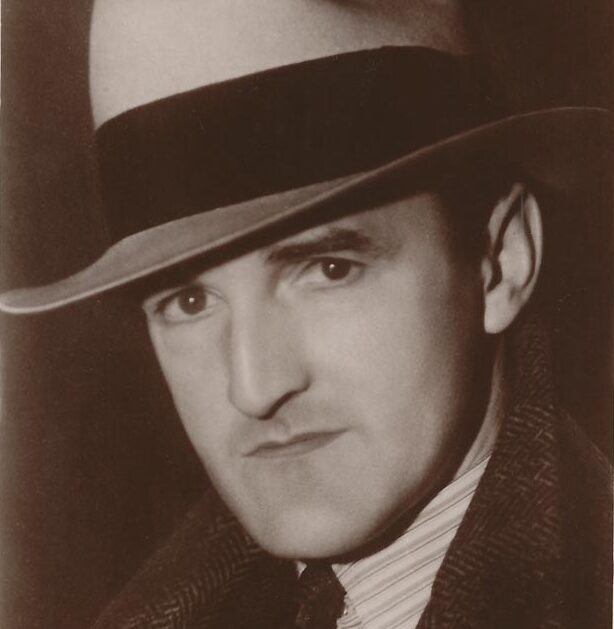
Percival Mackey

“Let’s Be Sentimental” (1930)

“Let’s Be Sentimental.” Lyrics by Desmond Carter, music by Vivian Ellis (1930). Recorded in London on October 23, 1930 by Percival Mackey and His Band with vocalist Maurice Elwin. Columbia CB-168 mx. WA-10818-2.

Personnel: Percival Mackey dir. Jack Jackson-Andy Richardson-t / Ben Oakley-tb / Chester Smith-another?-cl-as / George Smith-ts / Dave Fish-vn / Pat Dodd-p / Bob Martin-bj-g / Jim Bellamy-bb-sb / Billy Harty-d / Maurice Elwin-v

Percival Mackey and His Band – “Let’s Be Sentimental” (1930)
(Transfer by Henry Parsons)

“Let’s Be Sentimental” is, like many British dance band tunes, a delightful by-product of a not very successful London show. Little Tommy Tucker is the story of one Thomasina (“Tommy”) Tucker, the daughter of an impoverished baronet, who has to — you guessed it — “sing for her supper.” The man she has fallen in love with is betrothed to her sister. He does not love the sister, but his best friend does. Trying to get away from it all, Tommy ends up in Biarritz, impersonating a singer who has herself been pretending to be an exiled Russian princess. This is a comedy of errors reminiscent of the P. G. Wodehouse Blandings novels, insofar as several of the characters are always confused as to the others’ identities.

Little Tommy Tucker toured for six weeks, was partially recast and rewritten, and then lasted only two and a half months on the London stage.1 In spite of this lackluster performance, Pathé would release a film version the next year, although it used only two of the songs and renamed it Out of the Blue, after one of the songs. “Let’s Be Sentimental” is the other, and it is sung by Gene Gerard and Jessie Matthews.

The lyrics concern the supposed necessity of going through commonplace romantic gestures if romance is to succeed. There is some clever wordplay, but it is the tune that is truly daring. In each verse the melody gradually rises, then falls a fifth abruptly, rises a fifth, falls a fifth, and then rises and falls a third time. That pattern is likely to throw off a less than competent singer, and even then, there is the risk of sounding like a police siren. Composer Vivian Ellis must have liked the effect, as he used a toned-down version of it in “I’m on a See-Saw” in Jill Darling (1934).2

Percival Mackey must have felt bullish about Maurice Elwin, as it is the latter who introduces the unusual melody, and not the instrumentalists. By contrast, in the Jack Hylton version of “Let’s Be Sentimental,” first-rate vocalist Pat O’Malley comes in comparatively late in the recording3. It is my overall impression that Elwin leads with the vocals somewhat more often than other singers — I shall have to substantiate that claim over time — and I suspect that, if I am right, it is because he is reliably interesting without upstaging the band. There is little risk of doing that here, though: Percival Mackey’s band is at its most elegant in this piece, successfully executing the clever arrangement that puts foregrounded saxophones and violins in antiphonal conversation with muted brass.4
Arthur Lally

“I’ll Be the Same” (1930)

“I’ll Be the Same.” Composed by Jack Strachey. Recorded in London on June 5, 1930 by the Rhythm Maniacs under the musical direction of Arthur Lally with vocalist Maurice Elwin. Decca F-1814 mx. MB-1458-2.

Personnel: Arthur Lally-cl-as-bar dir. probably Norman Payne-Bill Shakespeare-t / Jock Fleming or Ted Heath-tb / Danny Polo-cl-as / Joe Jeanette-cl-ts / Claude Ivy-p / Joe Brannely-bj / Spike Hughes-sb / Bill Harty-d / Rudy Starita-vib-x / Maurice Elwin-v

The Rhythm Maniacs (v. Maurice Elwin) – “I’ll Be the Same” (1930)

I like to delve into songs’ origins, whether they be in London theater, Broadway, Tin Pan Alley, Hollywood, or elsewhere. Decca F-1814 presents a bit of a puzzle in this regard. The songwriter “Strachey” mentioned on its label would appear to be Jack Strachey, who wrote music for the theater and the music hall. His compositions would eventually see a fair amount of success; in later years he collaborated on “These Foolish Things (Remind Me of You). And yet Decca F-1814 seems to have the only known recordings of “I’ll Be the Same” and “Tell Me Over Again.” This one record is the sole testament that I can find to the songs’ ever having been written, which is strange, as they are both rather beautiful.

The title phrase “I’ll Be the Same” might at first appear to be an impossible pledge on the part of the singer never to change, advance, or decline (“You may alter; / I’ll be the same”). We gradually learn that he is actually promising fidelity in the face of inconstancy on the part of the song’s addressee. The song’s bittersweet theme is nicely expressed by the contrast between Maurice Elwin’s almost solemn interpretation of the lyrics and the exuberant instrumentals, which seem almost modern in their sensibility (and perhaps even in their volume level).

We should expect to see contrasts of this sort frequently when bandleader Arthur Lally uses Elwin as his vocalist. Elwin had the lion’s share of Lally vocals from 1929-1932, and sometimes his ability to sound serious and old-fashioned is comically juxtaposed with something silly and modern, such as Jack Jackson’s scatting. But in “I’ll Be the Same,” a tone of sincerity is actually called for thematically, and Elwin’s delivery of the vocal refrain makes this stylishly elegant recording surprisingly moving as well.

Bert and John Firman

“How’s Your Uncle?” (1931)

“How’s Your Uncle?” Lyrics by Dorothy Fields, music by Jimmy McHugh; composed for Shoot the Works (1931). Recorded in the Kingsway Hall, London c. October 23, 1931 by the Orpheus Dance Band under the musical direction of John Firman with vocalist Maurice Elwin. Zonophone 5987.

Personnel: John Firman dir. Max Goldberg-t / cl-as / cl-as-bar / cl-ts / ?Bert Read-p-cel / pac / Joe Brannelly-bj-g / Billy Bell-bb / Rudy Starita-vib-x / Maurice Elwin-v / Charles Saxby-or

Orpheus Dance Band – “How’s Your Uncle?” (1931) (Andy LeMaitre)

“How’s Your Uncle?” is a song deriving from the 1931 American revue Shoot the Works! (a slang expression referring to placing all of one’s money on a single bet). The show had been arranged as a way of providing temporary work for actors unemployed due to the Great Depression. The illustrious contributors to the revue (including “How’s Your Uncle?” songwriters Dorothy Fields and Jimmy McHugh) did not charge royalties for their work; instead, as much money as possible went to the cast.

Now, a revue involves singing, dancing, and sketch comedy, and the individual acts are held together by minimal, flimsy, or even no unifying narrative; the audience, including the reviewers, would not have expected much of a plot. In spite of those low expectations, apparently Shoot the Works! still lacked something important. New Yorker reviewer S. Finney wrote that it “had been put together with string,” and in spite of constant rewriting, it closed after only nine weeks.1

Fortunately, the failure of a revue does not vitiate its constituent parts, and “How’s Your Uncle?” saw great success with recording artists. The song’s lyrics consist of the sort of small talk (e.g. “How’s your uncle? How’s your auntie?”) that might lead up to a more important question (“And incidentally, baby, how are you?”). The questions about the more pedestrian aspects of life always precede the theme of love:

How's the cooking
And the washing
And the plumbing coming along?
Is the coffee
That you're making
Just as strong as your love for me?

The sing-song tune is catchy and perfectly suited to up-beat dance band arrangements.

The arrangement used by the Zonophone house orchestra, the Orpheus Dance Band, is particularly delightful, especially considering the interplay between the band and the organ played by Charles W. Saxby. There is also a wonderful sense of space in this recording. The echo that can be heard in Zonophone recordings made in Kingsway Hall is the polar opposite of the acoustically dead studios used by Decca in its otherwise excellent early recordings.

Maurice Elwin had been the Zonophone bands’ main vocalist since late 1927, so we should not be surprised to find him singing the refrain in “How’s Your Uncle?” He does seem perfectly suited for this song about the pedestrian sort of banter that people bury their real feelings in. Elwin’s approach to interpreting lyrics is famously understated, so to the extent that the song is a joke, Elwin could be said to be delivering it deadpan. He does alter his tone slightly when alluding to his love for the song’s addressee (and while asking after “the brother [he] could smother”), but for the most part he sounds like any one of us does when beating around the bush. The vocal refrain is subtly comical and contributes to the success of the whole recording.

Some American versions of “How’s Your Uncle” that were recorded while Shoot the Works! was still on stage were those of the Jesse Stafford Orchestra (v. Paul Small), the Troubadours (directed by Nat Shilkret, with vocalist Chick Bullock), and Fred “Sugar” Hall and His Sugar Babies (v. Arthur Fields).

Other British dance bands who recorded “How’s Your Uncle” in 1931 were Nat Star and His Dance Orchestra (v. Cavan O’Connor), Jerry Hoey and His Band (v. Les Allen and unknown person), Ambrose and His Orchestra (v. Sam Browne), the Filmophone House Band (v. Sam Browne), and Bidgood’s Good Boys (v. Tom Barratt).

  1. Dan Dietz, The Complete Book of 1930s Broadway Musicals, Washington, DC: Rowman & Littlefield, 2018, 138-140. ↩︎