Arthur Lally

“She’s My Slip of a Girl” (1930)

“She’s My Slip of a Girl.” Composed by Cyril Watters for the Melody Maker “All British Song Competition” (first prize, 1929). Recorded in Chelsea, London on January 31, 1930 by the Rhythm Maniacs under the musical direction of Arthur Lally with vocalist Maurice Elwin. Decca F-1630 mx. MB-914-2A. Personnel: Arthur Lally-cl-as-bar / Sylvester Ahola-Dennis Ratcliffe-t …

Arthur Lally

“Peter, Peter” (1929)

“Peter, Peter.” Music by Rudolf Nelson, words by Friedrich Hollaender (1929). Recorded by the Rhythm Maniacs with vocalist Maurice Elwin on November 28, 1929. Decca F-1608 mx. FMB-719-2. The transfer that I am sharing on the forty-seventh anniversary of Maurice Elwin’s death is a little unusual. The record that it is taken from is unfortunately …

Arthur Lally

“Tell Me Over Again” (1930)

“Tell Me Over Again.” Music and words by Jack Strachey. Recorded in London on June 5, 1930 by the Rhythm Maniacs under the musical direction of Arthur Lally with vocalist Maurice Elwin. Decca F-1814 mx. MB-1457-2. Personnel: Arthur Lally-cl-as-bar dir. probably Norman Payne-Bill Shakespeare-t / Jock Fleming or Ted Heath-tb / Danny Polo-cl-as / Joe …

Arthur Lally

“I’ll Be the Same” (1930)

“I’ll Be the Same.” Composed by Jack Strachey. Recorded in London on June 5, 1930 by the Rhythm Maniacs under the musical direction of Arthur Lally with vocalist Maurice Elwin. Decca F-1814 mx. MB-1458-2. Personnel: Arthur Lally-cl-as-bar dir. probably Norman Payne-Bill Shakespeare-t / Jock Fleming or Ted Heath-tb / Danny Polo-cl-as / Joe Jeanette-cl-ts / …

Arthur Lally, Bert and John Firman

“Somebody Mighty Like You” (Two Versions; 1930)

“Somebody Mighty Like You” originated in the partially Technicolor 1929 musical film Paris, whose plot concerns an upper-crust American man who causes a scandal by falling in love with a French cabaret girl. Less than two minutes of the actual movie still exist, although the soundtrack survives on Vitaphone discs. Paris was based on the …

Arthur Lally

“Nobody’s Using It Now” (1930)

“Nobody’s Using It Now.” Words by Clifford Grey, music by Victor Schertzinger. Composed for the film The Love Parade (1929). Recorded in London on March 31, 1930 by the Rhythm Maniacs under the musical direction of Arthur Lally with vocalist Maurice Elwin. Decca F-1716 mx. MB-1136-2. Personnel: Arthur Lally-cl-as-bar dir. Norman Payne-probably Bill Shakespeare-t / …

More on this topic

Arthur Lally

“Figaro” (1930)

“Figaro.” Words by Sidney D. Mitchell, music by Otto Motzan (1928). Recorded in Chelsea, London on May 20, 1930 by the Rhythm Maniacs under the musical direction of Arthur Lally with vocals by Maurice Elwin. Decca F-1799.

Personnel: Arthur Lally-cl-as-bar dir. probably Norman Payne-Bill Shakespeare-t / Jock Fleming or Ted Heath-tb / Danny Polo-cl-as / Joe Jeanette-cl-ts / Claude Ivy-p / Joe Brannelly-bj / Bill Harty-d / Rudy Starita-vib-x / Maurice Elwin-v / ?Jack Jackson-sc

The Rhythm Maniacs – “Figaro” (1930)
Transfer by Henry Parsons

Did the Rhythm Maniacs just reference the Figaro of Rossini’s Barber of Seville? They did, but only obliquely, as it turns out. The original lyrics of Mitchell and Motzan’s “Figaro” refer not to a Barber of Seville, but rather to a barber of Greenwich Village who likes to sing “Figaro, Figaro, Figaro”1 (whereas the Bidgood’s Broadcasters version relocates its “Figaro” to Saffron Hill, a London street housing Italian immigrants). In the Rhythm Maniacs version of “Figaro,” then, Maurice Elwin is not singing about the opera character Figaro, but about someone who thinks that he can sing opera.

The vocal refrain that Elwin is given is so short, at thirty-three seconds, that he does not get to specify who his “Figaro” is or where he lives and works. The lyrical excerpt has been torn from its context in the Mitchell-Motzan “Figaro,” so the repetition of “Figaro, Figaro, Figaro” and the general spirit of boasting that Elwin projects might actually lead us to recall the opening scenes of Rossini’s opera rather than the barber in New York or London. Elwin sings some generalities about “Figaro’s” attractiveness to the opposite sex and states that he is “the king of all.”

But Elwin ends up seeming like the straight man in a joke, as he is upstaged by another vocalist engaging in purposely comical scat. Rust and Forbes do not mention Jack Jackson’s presence at this session, but it sounds like him. One of the reasons that the scat sounds so awkward is that there is an additional joke of some sort embedded in it. Tim Machin of the Facebook Golden Age of British Dance Bands group is right, I think, to make out something like “Napoleon…one arm…could have been Nelson” embedded in amongst all the nonsensical vocalizations, and Nick Dellow suggests that there could even be a reference to the 1920s song “Why Sell Kippers in Pairs?” which has the line “Lord Nelson only had one eye and one arm, / So why sell kippers in pairs?”2

Other British dance bands who recorded “Figaro” in 1930 were the Savoy Orpheans (directed at the time by Ben Loban; v. Cavan O’Connor and chorus), Arthur Roseberry and His Dance Band (v. Leslie Holmes and chorus), the Debroy Somers Band (v. Tom Barratt), Jack Leon’s Dance Band (v. Jimmy Allen), Nat Star and His Dance Orchestra (as Selwyn’s Dance Orchestra; v. Tom Barratt), The Rhythmic Eight (directed by John Firman), the New Mayfair Dance Orchestra (dir. Ray Noble; v. Leonard Henry and Wally Vernon), Hal Swain and His Band (v. Fred Douglas), and (as mentioned above) Bidgood’s Broadcasters (as Ted Summer’s Dance Devils; v. Leslie Rome).
  1. Fred B. Diel, “In the World of Music Publishing,” The Music Trade Review, July 28, 1928, 22. ↩︎
  2. Comments on Henry Parsons, “To mark the debut of Alexandros Kozák’s new website,” Facebook, February 8, 2021. ↩︎
Arthur Lally, Bert and John Firman

“I’m the Medicine Man for the Blues” (1930)

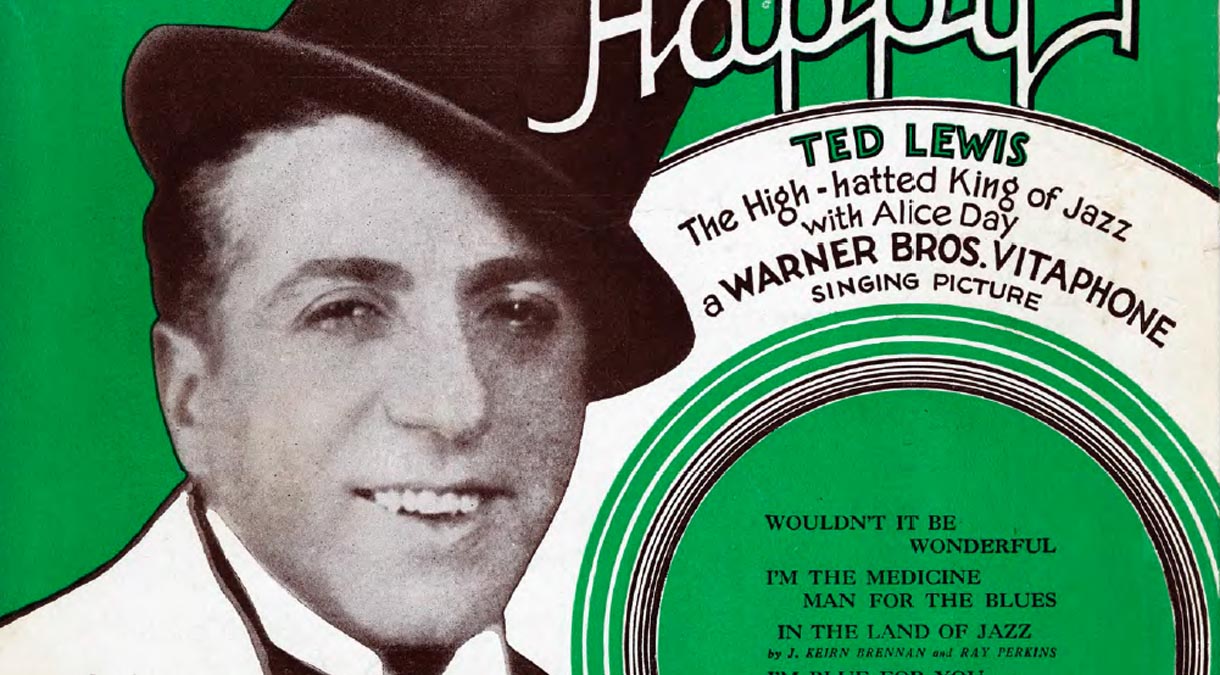
Surely two of the strangest recordings made by Maurice Elwin are his versions of “I’m the Medicine Man for the Blues,” a song written for Is Everybody Happy? (a Warner Brothers star vehicle for bandleader Ted Lewis). In order to understand what Elwin is doing with this song, it is important first to understand who Ted Lewis was. A self-styled “high-hatted tragedian of song,” Lewis led a commercially successful jazz band while wearing a battered top hat and playing a clarinet — badly. To his credit, he employed, at various times, first-rate instrumentalists such as Benny Goodman, Jimmy Dorsey, and Frank Teschemacher. On the other hand, though a non-singer, he insisted on doing vocals much of the time; the result was a lot of awkward speeches intoned over the music. He even had a way of making established song lyrics sound impromptu, and the result is highly irritating. A self-promoting, larger-than-life extrovert (perhaps comparable in some ways to Al Jolson), Lewis does not now enjoy the following he once had.

Is Everybody Happy? has been lost, although five minutes of it do survive; it is is worth watching the surviving footage if you want to understand his schtick (encountering real pirates, Lewis and his band claim to be pirates — for jazz). Lewis did make a record of “I’m the Medicine Man for the Blues,” and he does talk his way through this curious song praising the psychological benefits of music. Which brings us to Elwin.

“I’m the Medicine Man for the Blues.” Composed by Grant Clarke (words) and Harry Akst (music) for the Warner Brothers film Is Everybody Happy? (1929). Recorded in Studio A, Hayes, Middlesex on February 20, 1930 by Maurice Elwin under the musical direction of John Firman. Zonophone 5555.

Personnel: Sylvester Ahola-t / ?Arthur Lally-Danny Polo-as / Bert Read-p / Joe Brannelly-g / bb

Maurice Elwin – “I’m the Medicine Man for the Blues” (1930) (Transfer by John Wright)

Elwin’s Zonophone recording of “I’m a Medicine Man for the Blues” is a solo recording, which is to say that it foregrounds his singing, with the studio band backing him, and the record label has Elwin’s name, not the band’s, on it. What is so funny about this song is that Elwin, an excellent singer known for sounding unaffected, makes all sorts of gestures of tribute to Ted Lewis, who cannot sing and who comes across as schmaltzy and decidedly insincere. You can tell that Elwin has seen the sheet music, because he sings plenty of real notes, but he keeps veering off into an approximation of Ted Lewis’s loud declaiming.

“I’m the Medicine Man for the Blues” (Clarke-Akst; 1929). Recorded in Chelsea, London on March 5, 1930 by the Rhythm Maniacs under the musical direction of Arthur Lally with vocalist Maurice Elwin. Decca F-1677.

Arthur Lally-cl-as-bar dir. Sylvester Ahola-Dennis Ratcliffe-t / Ted Heath-tb / Danny Polo-cl-as / Joe Jeanette-cl-ts / Claude Ivy-p / Joe Brannelly-bj / Spike Hughes-sb / Max Bacon-d / Rudy Starita-vib-x / Maurice Elwin-v

The Rhythm Maniacs (v. Maurice Elwin) – “I’m the Medicine Man for the Blues” (1930)

You will note that, while made at a different studio with a different musical director, the Rhythm Maniacs version of “I’m the Medicine Man for the Blues” has a lot of the same instrumentalists. The sound engineers are a very different story, however: this recording is blaringly loud in that familiar, early Decca way. The arrangement is truly inspired, and someone is either tap-dancing or doing a very good approximation of the sound. Maurice Elwin’s briefer vocal on this record also acknowledges Ted Lewis; Elwin talks his way through some of the lyrics, although he cannot help singing others nicely. He fully embraces the spirit of boasting derived from the lyrics and from Lewis’s interpretation of them.

These offbeat recordings give us an idea of how unlike himself Elwin was willing to be. They are outliers, but they were clearly done in good fun by an artist who did not mind seeming a bit ridiculous. It is hard to think of two men from this era with singing personas more different than Lewis’s and Elwin’s, and it is funny to think of what the latter must have looked like when he committed these somewhat bizarre songs to shellac.

Another British version of “I’m the Medicine Man for the Blues” was recorded in 1930 by Tommy Kinsman’s Florida Band (v. Harry Bentley, who gives the song a fairly straight interpretation). In America in 1929-1930, in addition to Ted Lewis’s own record, there were versions done by Nat Shilkret and the Victor Orchestra (v. Johnny Marvin) and by the Campus Cut-Ups.

Arthur Lally

“Jus’ Keepin’ On” (1930)

There is a curious relationship between Maurice Elwin, the Rhythm Maniacs, and the odd, forgotten song “Jus’ Keepin’ On.” The Rhythm Maniacs are the only musicians I have identified who recorded it. What is more, they recorded it at three different sessions, each time giving Maurice Elwin more time to vocally express its bizarre, plodding themes of exhaustion and resignation.

“Pantomime Hits — Selection — Part 1” (Intro. “Jericho” / “You’re My Silver Lining of Love” / “Jus’ Keepin’ On”). Recorded in Chelsea, London on November 27, 1929 by Philip Lewis and His Orchestra (a.k.a. the Rhythm Maniacs) under the musical direction of Arthur Lally with vocalist Maurice Elwin. Decca F-1585.

Personnel: Arthur Lally-cl-as-bar dir. Sylvester Ahola-Dennis Ratcliffe-t / Ted Heath-tb / Danny Polo-cl-as / Johnny Helfer or Joe Crossman-cl-ts / Claude Ivy-p / Joe Brannelly-bj / Tiny Stock-bb / Max Bacon-d-vib / Maurice Elwin-v

Philip Lewis and His Orchestra (a.k.a the Rhythm Maniacs; v. Maurice Elwin)
“Pantomime Hits — Selection — Part 1” (1929)
(Transfer by John Wright)

The first recording was on November 27, 1929, where “Jus’ Keepin’ On” was the last element in the issued medley “Pantomime Hits — Selection, Part 1.” It is worth noting that Elwin sings the lyric conventionally, sticking to the melody. His voice is soft and he sounds slightly weary, but there is nothing resembling overacting going on.

On December 16, the Rhythm Maniacs would record two rejected takes of the whole song. It is worth noting that in take 1 Maurice Elwin sings a fairly straight version of the tune before launching into a declamation about halfway through the song that is intoned, not sung. The last third of the first take is a fairly uninspired instrumental treatment of the refrain.

“Jus’ Keepin’ On.” Composed by Alexander Phillips (a.k.a. Van Phillips). Recorded in Chelsea, London on January 16, 1930 by the Rhythm Maniacs under the musical direction of Arthur Lally with vocals by Maurice Elwin. Decca F-1586 mx. MB-765-3.

Personnel: Arthur Lally-cl-as-bar dir. Sylvester Ahola-Dennis Ratcliffe-t / Danny Polo-cl-as / Joe Jeannette-cl-ts / Claude Ivy-p / Joe Brannelly-bj / Tiny Stock-bb / Max Bacon-d-vib / Maurice Elwin-v

The Rhythm Maniacs – “Jus’ Keepin’ On” (1930)
(Transfer by Henry Parsons)

The issued third take (recorded on January 16, 1930) has Elwin very much in the foreground for almost the entire recording. If he was ever at risk of being a little histrionic, he is here in this remarkable recording (although perhaps we should reserve a place of honor for “I’m the Medicine Man for the Blues”). He sings, declaims, and sings again, dominating almost the entire booming, high-gain early Decca recording. I have the feeling that Arthur Lally must have come to the realization that the underlying composition was not really all that good, but that it would be incredibly funny to have a normally subtle vocalist bellow it out. By having Elwin ham it up a bit for comic effect, Lally (presumably) rescued what would otherwise be a rather wearying song about weariness.

I should add that, vis-à-vis declaiming lyrics in place of singing them, there is a reason we might lump Elwin’s performance in the Rhythm Maniacs’ “Jus’ Keepin’ On” together his two interpretations of “I’m the Medicine Man for the Blues.” It would appear that Elwin went through a phase of imitating Ted Lewis, who introduced the latter song, and who, being a poor singer, was prone simply to speak lyrics, often in an odd, sentimental way, with slight diversions and repetitions. I hear Maurice Elwin doing the same in many of his solo Zonophone and Decca recordings of this period. I look forward to eventually sharing some of them on this website.