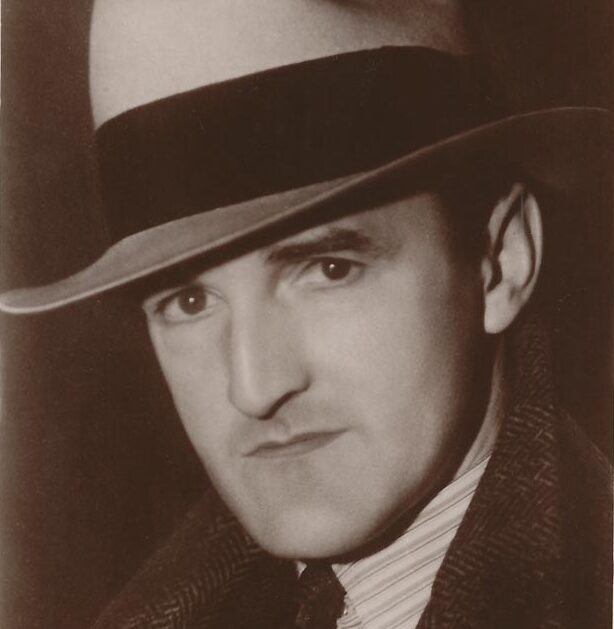
Bert and John Firman

“Slow Music” (1928)

“Slow Music” (Lax-Craig). Recorded in B Studio, Hayes, Middlesex on October 17, 1928 by the Rhythmic Eight (under the musical direction of John Firman) with vocalists Maurice Elwin, Arthur Lally, and Johnny Helfer. Zonophone 5233 (and Salabert FZ-950) mx. Yy-14801-2.

Personnel: John Firman dir. Sylvester Ahola-t / Arthur Lally-cl-as-bar-v / Jack Miranda-as-bar / Johnny Helfer-cl-ts-v / ?Bert Read-p / Joe Brannelly-bj / Billy Bell-bb / Rudy Starita-d / Maurice Elwin-v

The Rhythmic Eight (v. Maurice Elwin, Arthur Lally, and Johnny Helfer) – “Slow Music” (1928)

“Slow Music” is, paradoxically, an eminently memorable song that has been almost entirely overlooked by artists; indeed, the Rhythmic Eight recording of it may be the only one ever made. Even the songwriters are obscure. “Lax” being a comparatively rare surname, I would venture to guess that one songwriter was the Arnold T. Lax whose hometown newspaper declared him to be a “second [Irving] Berlin,”1 although I do not recognize any of his other known compositions, while “Craig” (presumably misspelled on my Salabert disc as “Graig”) might be the Edward F. Craig who collaborated with Lax on one other song.2

The only recording, then, of “Slow Music,” was made at an unusual Rhythmic Eight session where Maurice Elwin, at that time the band’s go-to singer, was joined in a vocal trio by saxophonist Arthur Lally and reed player Johnny Helfer. The three work well together, though the difference in singing experience is apparent. Elwin’s voice is readily identifiable throughout. In “Slow Music,” I was surprised not to be able to detect the familiar idiosyncrasies of Arthur Lally’s voice (which can be heard speaking and occasionally singing on quite a few British dance band records — perhaps best in the Million-Airs’ “Just a Crazy Song”), but the final song recorded at the October 17, 1928 session, “This Is the Way the Puff-Puff Goes,” features only Helfer and Lally doing distinct vocal parts, and there Lally is definitely recognizable.

The Rhythmic Eight’s “Slow Music” features a mesmerizing arrangement, and the vocal harmony evokes a moody atmosphere. It is funny to note that this, the only known treatment of the song, is not particularly slow — a detail which may be due entirely to the judgment of director John Firman.

The recording serves as a reminder that Elwin was a singer who frequently collaborated in duets, trios, and even quartets (as with the Ramblers). I never seem to have difficulty detecting his voice in a group, but that is not to say that he dominates the overall sound unduly or fails to blend with his collaborators. Rather, I would say that he possessed certain vocal strengths that stand out in almost any context. The Rhythmic Eight themselves definitely stand out as a virtuoso group on this occasion, as always, with Sylvester Ahola’s trumpet performance being particularly noteworthy.

  1. Portland [Maine, USA] Evening Express, “Arnold T. Lax is Second Berlin As Composer of Song,” December 15, 1926, newspapers.com. ↩︎
  2. “’Mid Roses Twining.” ↩︎
Bert and John Firman

“Sweetheart’s Holiday” (1930)

“Sweetheart’s Holiday.” Music by J. Russel Robinson, words by Irving Kahal. Recorded in Studio A, Hayes, Middlesex on January 24, 1930 by the Rhythmic Eight under the musical direction of John Firman with vocalist Maurice Elwin. Zonophone 5559 mx. Yy-18307-3.

Personnel: John Firman dir. Sylvester Ahola-t / Danny Polo-cl-as-bar / ?E. O. Pogson-cl-as / Johnny Helfer-cl-ts / Bert Read-p / Joe Brannelly-bj / Billy Bell-bb / Rudy Starita-d-vib-x / Maurice Elwin-v

The Rhythmic Eight (v. Maurice Elwin) – “Sweetheart’s Holiday”

“Sweetheart’s Holiday”1 was composed by J. Russel Robinson (who had been a member of the Original Dixieland Jazz Band and who had written “Singin’ the Blues”), with words by Irving Kahal (who would, the next year, write the words for the hits “You Brought a New Kind of Love to Me” and “By a Waterfall”). The incredibly catchy tune’s lyrics repeatedly reference an upcoming tryst (a “sweetheart’s holiday”) with a “steady” (slang for boyfriend or girlfriend); personified aspects of nature (the moon and the birds, for example) are described as taking part in the preparations for lovers’ rendezvous.

In the peppy Rhythmic Eight version of “Sweetheart’s Holiday,” the individual virtuosity of the players is very much in evidence. Particularly memorable is a segment where Bert Read achieves a ragtime piano sound, accompanied by Rudy Starita on the drums (the cymbals would appear to be rather near the microphone2). The latter’s playing approximates the sound of tap-dancing feet.

Maurice Elwin’s vocal refrain is upbeat and does credit to the song’s admirable wordplay. It is a comparatively short vocal interlude but memorable, nonetheless. I first heard this song in the Tom Clines version, where Jack Carney provides elegant but somewhat awkward and mannered vocals. Elwin, by comparison, sounds natural and youthfully enthusiastic. The overall effect is perhaps most comparable to Elwin’s vocal chorus in the Rhythm Maniacs version of “She’s My Slip of a Girl” (recorded only a week after “Sweetheart’s Holiday”), where he also engages in a rapid-fire delivery of playful love lyrics.

“Sweetheart’s Holiday” was recorded in the United States in 1929 by Jerry Macy and Ed Smalle, The New Yorkers, Tom Clines and His Music (v. Jack Carney), Tom Gott and His Rose Room Orchestra (v. Scrappy Lambert), Ted Wallace and His Campus Boys (v. Smith Ballew), Walter Cummins, Henry Busse and His Orchestra (v. Richard Barry), Lee Morse, and Charles W. Hamp. It was also sung by Georgie Price in a Vitaphone short, Don’t Get Nervous.

It was recorded in Britain in 1929 by The Savoy Plaza Band (dir. Les. Norman/v. by unknown person) and by Bidgood’s Broadcasters (as Nat Lewis and His Dance Band/v. Tom Barratt).

Bert and John Firman

“Sweet and Lovely” (1931)

“Sweet and Lovely.” Words and music by Gus Arnheim, Harry Tobias, and Charles N. Daniels (using the pseudonym Jules Lemare; 1931). Recorded in the Kingsway Hall, London c. October 23, 1931 by the Orpheus Dance Band (under the musical direction of John Firman) with vocalist Maurice Elwin. Zonophone 5987 mx. 0Y-1506-2.

Personnel: John Firman dir. Max Goldberg-t / cl-as / cl-as-bar / cl-ts / ?Bert Read-p-cel / pac / Joe Brannelly-bj-g / Billy Bell-bb / Rudy Starita-d-vib-x / Charles W. Saxby-or / Maurice Elwin-v

Orpheus Dance Band (v. Maurice Elwin) – “Sweet and Lovely” (1931)

I have yet to find a version of “Sweet and Lovely” that I do not like. A creation of lyricist Harry Tobias, composer-lyricist Charles N. Daniels, and California-based bandleader Gus Arnheim1, the song was surprisingly effective at using its unusual melody to elevate romantic attraction to the spiritual plane. It became Arnheim’s signature tune, but the Orpheus Dance Band’s version with Maurice Elwin stands out as something special.

John Firman’s Zonophone house band used the pseudonym “The Orpheus Dance Band” when it recorded in the Kingsway Hall with Charles W. Saxby on the organ (the name “The Arcadians Dance Orchestra” had been used for that purpose up until 1930). In “Sweet and Lovely,” the organ and Billy Bell’s tuba establish a mellow pulsation for the other instruments to play off of. The effect is decidedly hypnotic; it establishes a sort of dream state for Maurice Elwin’s vocals to emerge from.

On this website I say a lot about Elwin’s precision as a singer and about how funny he can be, but “Sweet and Lovely” gives us an example of his being incredibly tender. He is operating at the higher end of his baritone range, which makes him sound more emotionally vulnerable, and he moves through the vocal chorus just quickly enough to give the impression that he is being carried away — transported — by his own argument. I come away from listening to this recording feeling younger and less jaded, convinced of the higher potential of romantic love.

Some representative American recordings of “Sweet and Lovely” made in 1931 are those by Gus Arnheim and His Cocoanut Grove Orchestra (v. Donald Novis), Ben Selvin (as Phil Hughes and His High Hatters; v. Jack Miller), Bing Crosby (whose version includes the intro that would have been in the sheet music but that was dropped in band arrangements), and Ed Kirkeby (as Bud Leonard; v. Elmer Feldkamp).

Other British dance band recordings were made in 1931 by Roy Fox and His Band (v. Al Bowlly), Dave Frost and His Band (v. Sam Browne), Jerry Hoey and His Band (v. Les Allen and two unknown singers), The Savoy Hotel Orpheans (dir. Howard Jacobs; v. Al Bowlly), Percival Mackey and His Kit-Cat Band (v. Phyllis Robins), Eddie Grossbart and His Café de Paris Band (unknown vocalistPathé footage survives of Grossbart’s band performing “Sweet and Lovely” in the Café de Paris itself), Jack Harris and His Grosvenor House Band (v. Harry Bentley), Ambrose and His Orchestra (v. Sam Browne), Jack Payne and His Band, and Jack Hylton and His Orchestra (v. Pat O’Malley, in a 12″ concert arrangement). Jay Wilbur recorded three different versions in November and December 1931: one as Jay Wilbur and His Band (with an unknown vocalist), and two as the Biltmore Players (one with Sam Browne and one with Les Allen).

  1. It is possible that Arnheim’s contributions were minimal, but he did have past experience with songwriting. ↩︎