Ronnie Munro

“The Riff Song” (1927)

“The Riff Song.” Words by Otto Harbach, Oscar Hammerstein 2nd, and Frank Mandel, with music by Sigmund Romberg. Recorded in London in February 1927 by Ronnie Munro and His Dance Orchestra, with vocals by Maurice Elwin. Ariel 4251 (from Parlophone E-5762) mx. E-1206-1.

Personnel: Ronnie Munro-p dir. Jack Jackson-Max Goldberg-Frank Wilson-Lloyd Shakespeare-t / Lew Davis-tb / Charlie Swinnerton-Ben Davis-?Nat Star-cl-as / Buddy Featherstonhaugh-cl-ts / vn / Barry Mills or Carrol Gibbons-2nd p / Len Shevill-bj-g / bb-sb / Max Bacon-d-vib / Wag Abbey-Rudy Starita-d-x / Maurice Elwin-v

Ronnie Munro (v. Maurice Elwin) – “The Riff Song” (1927)

From 1921 to 1926, Moroccan Berber insurgents known as Riffians (named for the mountainous Rif region) rebelled against the colonizing forces of Spain. The Riffians proved to be formidable and skilled opponents, in spite of the asymmetry of the warfare (with the Spanish using aircraft and even chemical weapons). It was only with the intervention in 1924 of France (which had its own protectorate in Morocco), aided by American mercenary aviators, that the Berbers began to falter. In 1926 they were forced to surrender.

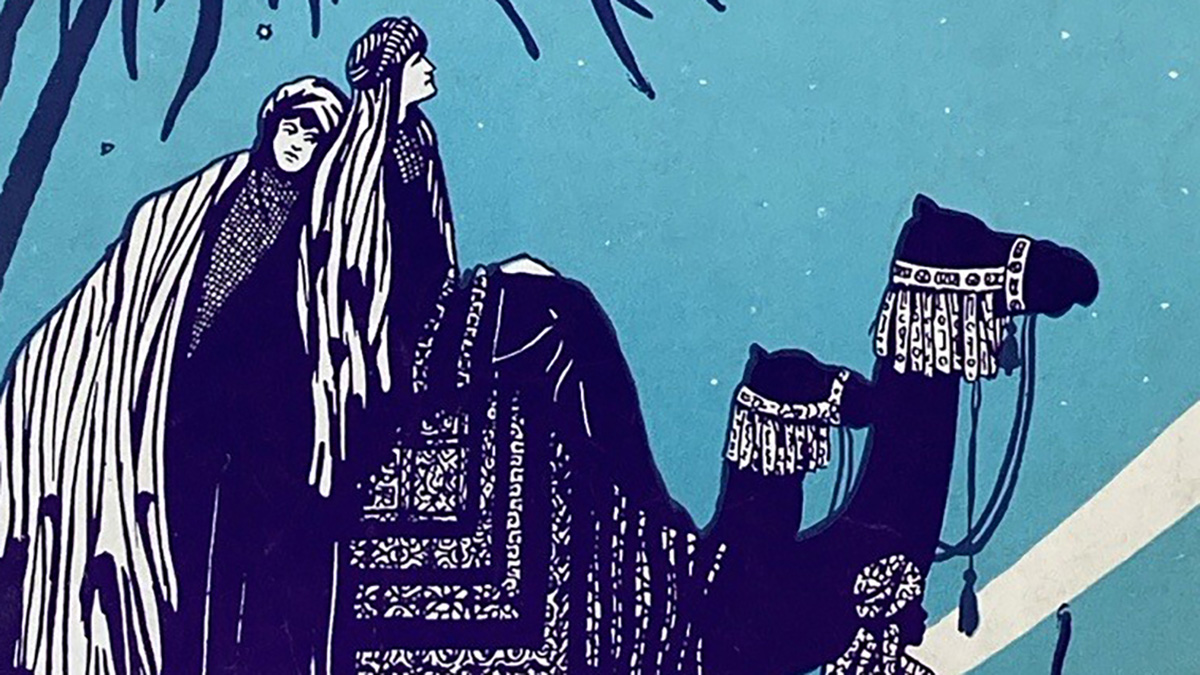
Meanwhile, in America (which was trying to remain neutral), Hungarian-born composer Sigmund Romberg and his team of lyricists (Harbach, Hammerstein, and Mandel) seem to have gauged that popular revulsion at the involvement of the American mercenaries in what was perceived as an unfair conflict, as well as a growing vogue for all things Saharan, would create an enthusiastic audience for an operetta sympathizing with the Riffians. The Desert Song had a convoluted plot involving a masked white savior character named Pierre, who, while posing as a Berber and leading the Riffians against the French, is actually himself French and even the son of the French general opposing the Berbers. As the rebel leader “the Red Shadow,” Pierre leads a double life comparable to those of the Scarlet Pimpernel and Zorro (a more recent parallel would be Superman/Clark Kent). Early in the drama, he sings “The Riff Song,” in which he boasts of the valor and prowess of “the Riffs” (i.e., the Riffians) and the Red Shadow.

Ronnie Munro’s arrangement of the song is similar to the one that American Don Voorhees had used the previous year and includes a few (possibly not very authentic) gestures in the direction of world music that nevertheless serve to summon a feeling of place. Maurice Elwin is given just one brief iteration of the chorus to sing, but it stands out as a particularly impressive vocal performance. Elwin had had his formal education at the Royal Academy of Music, where operatic technique would have been a mainstay of instruction. It is pleasing to hear him applying his training judiciously in the context of operetta.

“The Riff Song” was recorded in America in 1926 by Nat Shilkret and the Victor Orchestra (v. The Revelers) and by Don Voorhees and His Earl Carroll Vanities Orchestra (v. The Shannon Quartet). In 1927, British artists who recorded “The Riff Song” include Alfredo’s Band, the Savoy Orpheans (dir. Carroll Gibbons), Jack Payne and His Hotel Cecil Orchestra (v. orchestra), the Debroy Somers Band (in a Desert Song medley), Harry Bidgood’s Orchestra (on Aco and Coliseum with vocalist John Thorne and on Broadcast with Bobby Sanders), Stan Greening’s New Regenta Orchestra (in a Desert Song medley), and Bert Firman’s Dance Orchestra (as Eugene Brockman’s Dance Orchestra).

Arthur Lally

“She’s My Slip of a Girl” (1930)

“She’s My Slip of a Girl.” Composed by Cyril Watters for the Melody Maker “All British Song Competition” (first prize, 1929). Recorded in Chelsea, London on January 31, 1930 by the Rhythm Maniacs under the musical direction of Arthur Lally with vocalist Maurice Elwin. Decca F-1630 mx. MB-914-2A.

Personnel: Arthur Lally-cl-as-bar / Sylvester Ahola-Dennis Ratcliffe-t / Ted Heath-tb / Danny Polo-cl-as / Joe Crossman or Johnny Helfer-cl-ts / Claude Ivy-p / Joe Brannelly-bj / Spike Hughes-sb / Max Bacon-d-vib / Maurice Elwin-v / Lew Stone-a1

The Rhythm Maniacs (v. Maurice Elwin) – “She’s My Slip of a Girl” (1930)

“She’s My Slip of a Girl” won first prize in the 1929 Melody Maker magazine “All British Song Competition,” which aimed to identify a foxtrot “considered worthy of holding its own with foreign importations.”2 The judges included C. B. Cochran, Noel Coward, and Jack Hylton, and there were 500 competitors. The prize was taken by Cyril Watters, a twenty-two-year-old pianist and musical clerk who would go on to compose over 250 songs and win many more prizes in the coming decades.

“She’s My Slip of a Girl” is undeniably catchy, even infectious, with its anapestic patter and rapid-fire rhyme scheme. The singer speaks of his elation (verging on ecstasy) at somehow having been so fortunate as to have a certain slender or otherwise diminutive type of woman in his life. The B part is particularly precious:

Maybe she's not a beauty,
But beauty's only skin deep.
She's the kind of a cutie
Knocks 'em all of a heap.

I know of no other lyrics that express so well the idea of a visceral attraction that transcends conventional standards for good looks.

Of the four British versions recorded of “She’s My Slip of a Girl,” the Rhythm Maniacs’ version best captures the trance-inducing qualities of the tune, which is repetitive yet never dull. As with many early Decca recordings, the sound engineers set the gain very high, and the song is blaringly loud. The result is that it almost pulsates, bringing out the nearly primal appeal of the Lew Stone arrangement. A quick scan over the personnel list reveals that the Rhythm Maniacs at this time were almost a subset of Ambrose’s orchestra.

One effect of the song’s high volume is the contrast between the blaring instrumental parts and Maurice Elwin’s vocal. The latter sounds deeply earnest — who would expect otherwise from Elwin? — but he is also enthusiastic, almost impassioned. There is considerable warmth in his voice. At a couple of points the melody goes rather high, and the baritone follows it upwards deftly, allowing himself to sound momentarily more vulnerable, as men sometimes do when they successfully sing above their usual range.

“She’s My Slip of a Girl” encapsulates for me one of the things that I love generally about Elwin: he is a fundamentally calm, mellow singer with a wholesome-sounding voice who found himself working with some of Britain’s hottest bands (I think particularly of the Firman bands along with Lally’s studio orchestras). To a certain extent he introduces a pleasant contrast with his comparatively composed vocal refrains, but at no time does he sound out of place.

To appreciate the brilliance of the Rhythm Maniac’s version of “She’s My Slip of a Girl” requires us to compare the other contemporary interpretations of the song, which happen to be all very good in their own ways. Eddie Hardie and His Night Club Boys recorded a December 1929 version on Piccadilly with a Harry Bentley vocal that is slow and bluesy. The same month, Ray Noble’s New Mayfair Dance Orchestra made a booming but elegant one, also comparatively slow, with touching vocals by Pat O’Malley, who scats gently at the end of the recording. In March 1930, Jack Payne and His BBC Dance Orchestra did a purely instrumental interpretation of the tune that must be at least as fast as the Rhythm Maniacs and whose arrangement is marked by amusing variations on the underlying tune that keep it from seeming overly repetitious. Finally, there is an interesting French version that I think may be a response to the Rhythm Maniacs.

  1. My thanks to Mike Thomas for providing me with the correct personnel lineup. ↩︎
  2. Daily Mirror, January 1, 1930, 4, British Newspaper Archive. ↩︎
Bert and John Firman

“Slow Music” (1928)

“Slow Music” (Lax-Craig). Recorded in B Studio, Hayes, Middlesex on October 17, 1928 by the Rhythmic Eight (under the musical direction of John Firman) with vocalists Maurice Elwin, Arthur Lally, and Johnny Helfer. Zonophone 5233 (and Salabert FZ-950) mx. Yy-14801-2.

Personnel: John Firman dir. Sylvester Ahola-t / Arthur Lally-cl-as-bar-v / Jack Miranda-as-bar / Johnny Helfer-cl-ts-v / ?Bert Read-p / Joe Brannelly-bj / Billy Bell-bb / Rudy Starita-d / Maurice Elwin-v

The Rhythmic Eight (v. Maurice Elwin, Arthur Lally, and Johnny Helfer) – “Slow Music” (1928)

“Slow Music” is, paradoxically, an eminently memorable song that has been almost entirely overlooked by artists; indeed, the Rhythmic Eight recording of it may be the only one ever made. Even the songwriters are obscure. “Lax” being a comparatively rare surname, I would venture to guess that one songwriter was the Arnold T. Lax whose hometown newspaper declared him to be a “second [Irving] Berlin,”1 although I do not recognize any of his other known compositions, while “Craig” (presumably misspelled on my Salabert disc as “Graig”) might be the Edward F. Craig who collaborated with Lax on one other song.2

The only recording, then, of “Slow Music,” was made at an unusual Rhythmic Eight session where Maurice Elwin, at that time the band’s go-to singer, was joined in a vocal trio by saxophonist Arthur Lally and reed player Johnny Helfer. The three work well together, though the difference in singing experience is apparent. Elwin’s voice is readily identifiable throughout. In “Slow Music,” I was surprised not to be able to detect the familiar idiosyncrasies of Arthur Lally’s voice (which can be heard speaking and occasionally singing on quite a few British dance band records — perhaps best in the Million-Airs’ “Just a Crazy Song”), but the final song recorded at the October 17, 1928 session, “This Is the Way the Puff-Puff Goes,” features only Helfer and Lally doing distinct vocal parts, and there Lally is definitely recognizable.

The Rhythmic Eight’s “Slow Music” features a mesmerizing arrangement, and the vocal harmony evokes a moody atmosphere. It is funny to note that this, the only known treatment of the song, is not particularly slow — a detail which may be due entirely to the judgment of director John Firman.

The recording serves as a reminder that Elwin was a singer who frequently collaborated in duets, trios, and even quartets (as with the Ramblers). I never seem to have difficulty detecting his voice in a group, but that is not to say that he dominates the overall sound unduly or fails to blend with his collaborators. Rather, I would say that he possessed certain vocal strengths that stand out in almost any context. The Rhythmic Eight themselves definitely stand out as a virtuoso group on this occasion, as always, with Sylvester Ahola’s trumpet performance being particularly noteworthy.

  1. Portland [Maine, USA] Evening Express, “Arnold T. Lax is Second Berlin As Composer of Song,” December 15, 1926, newspapers.com. ↩︎
  2. “’Mid Roses Twining.” ↩︎