People who read my website are likely to be familiar with my good friend Jonathan Holmes, whose journalism, general music advocacy, and YouTube channel have made him almost synonymous with British dance band music:
Jonathan Holmes
Jonathan interviewed me yesterday for his “British Dance Music Programme.” We played Elsie Carlisle songs, discussed her art, life, and career, and chatted about the elsiecarlisle.com website that I’ve been running for the past seven years. We also talked a little about Maurice Elwin and my plans for this website. The interview will be broadcast several times tomorrow, Friday, February 26, on Phonotone Classic. Check out their website to tune in; I should be on at
“You’re Mine, You.” Words by Edward Heyman, music by Johnny Green (1933). Recorded in London on May 25, 1933 by Carroll Gibbons and the Savoy Hotel Orpheans with vocals by Maurice Elwin. Columbia CB-620 mx. CA-13664-3.
Personnel: Carroll Gibbons-p dir. Bill Shakespeare-Billy Higgs-t / Arthur Fenoulhet-t-tb / Paul Fenoulhet-tb / Sam Acres-tb / George Melachrino-cl-as-vn / Laurie Payne-cl-as-bar / George Smith-ts / Ben Frankel-vn / Sid Bright-2nd p / Harry Sherman-g / Jack Evetts-sb / Rudy Starita-d-vib-x / Maurice Elwin-v / Stanley Andrews-a
Carroll Gibbons and the Savoy Hotel Orpheans (v. Maurice Elwin) “You’re Mine, You” (1933) (Transfer by Charles Hippisley-Cox)
I usually think of Maurice Elwin’s vocal personas as being so wholesome that I am almost surprised to hear him sing the lyrics of “You’re Mine, You”:
I own you:
I don't need to buy love;
You're a slave to my love.
In every way, you're mine.
Elwin sings these words with a surprising intensity. I am also struck by how well he sings the higher notes. He has some of the smoothness that I associate with his friend Jack Plant, but Elwin’s voice is less stylized and thus potentially more relatable. I have to admit that the first time I heard his voice, I thought he sounded like a bemused Sunday school teacher, but here he proves that he can evoke a sense of romantic passion and make it sound genuine.
One cannot write about “You’re Mine, You” without mentioning Al Bowlly’s recording of it with Ray Noble and His Orchestra. There is not much reason to think of Elwin’s version as having influenced Al Bowlly; the latter is unlikely to have heard it before recording the song himself. I find absolutely nothing lacking in Al Bowlly’s rendition of “You’re Mine, You”; it is one of his best songs. I think it is therefore great praise to say that, compared to Bowlly, Elwin holds his own. We know that Elwin himself had the highest regard for Bowlly’s talent and praised him publicly in the most admirable terms.1
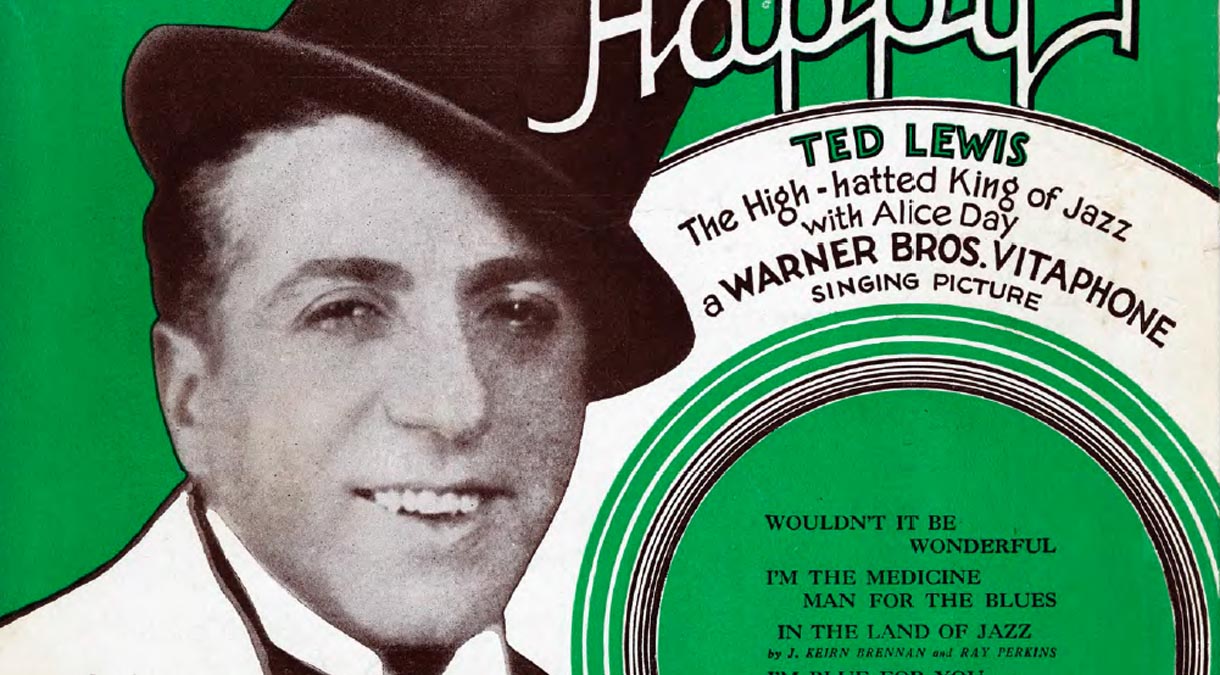
Surely two of the strangest recordings made by Maurice Elwin are his versions of “I’m the Medicine Man for the Blues,” a song written for Is Everybody Happy? (a Warner Brothers star vehicle for bandleader Ted Lewis). In order to understand what Elwin is doing with this song, it is important first to understand who Ted Lewis was. A self-styled “high-hatted tragedian of song,” Lewis led a commercially successful jazz band while wearing a battered top hat and playing a clarinet — badly. To his credit, he employed, at various times, first-rate instrumentalists such as Benny Goodman, Jimmy Dorsey, and Frank Teschemacher. On the other hand, though a non-singer, he insisted on doing vocals much of the time; the result was a lot of awkward speeches intoned over the music. He even had a way of making established song lyrics sound impromptu, and the result is highly irritating. A self-promoting, larger-than-life extrovert (perhaps comparable in some ways to Al Jolson), Lewis does not now enjoy the following he once had.
Is Everybody Happy? has been lost, although five minutes of it do survive; it is is worth watching the surviving footage if you want to understand his schtick (encountering real pirates, Lewis and his band claim to be pirates — for jazz). Lewis did make a record of “I’m the Medicine Man for the Blues,” and he does talk his way through this curious song praising the psychological benefits of music. Which brings us to Elwin.
“I’m the Medicine Man for the Blues.” Composed by Grant Clarke (words) and Harry Akst (music) for the Warner Brothers film Is Everybody Happy? (1929). Recorded in Studio A, Hayes, Middlesex on February 20, 1930 by Maurice Elwin under the musical direction of John Firman. Zonophone 5555.
Maurice Elwin – “I’m the Medicine Man for the Blues” (1930) (Transfer by John Wright)
Elwin’s Zonophone recording of “I’m a Medicine Man for the Blues” is a solo recording, which is to say that it foregrounds his singing, with the studio band backing him, and the record label has Elwin’s name, not the band’s, on it. What is so funny about this song is that Elwin, an excellent singer known for sounding unaffected, makes all sorts of gestures of tribute to Ted Lewis, who cannot sing and who comes across as schmaltzy and decidedly insincere. You can tell that Elwin has seen the sheet music, because he sings plenty of real notes, but he keeps veering off into an approximation of Ted Lewis’s loud declaiming.
“I’m the Medicine Man for the Blues” (Clarke-Akst; 1929). Recorded in Chelsea, London on March 5, 1930 by the Rhythm Maniacs under the musical direction of Arthur Lally with vocalist Maurice Elwin. Decca F-1677 mx. MB-1023-2.
Arthur Lally-cl-as-bar dir. Sylvester Ahola-Dennis Ratcliffe-t / Ted Heath-tb / Danny Polo-cl-as / Joe Jeanette-cl-ts / Claude Ivy-p / Joe Brannelly-bj / Spike Hughes-sb / Max Bacon-d / Rudy Starita-vib-x / Maurice Elwin-v
You will note that, while made at a different studio with a different musical director, the Rhythm Maniacs version of “I’m the Medicine Man for the Blues” has a lot of the same instrumentalists. The sound engineers are a very different story, however: this recording is blaringly loud in that familiar, early Decca way. The arrangement is truly inspired, and someone is either tap-dancing or doing a very good approximation of the sound. Maurice Elwin’s briefer vocal on this record also acknowledges Ted Lewis; Elwin talks his way through some of the lyrics, although he cannot help singing others nicely. He fully embraces the spirit of boasting derived from the lyrics and from Lewis’s interpretation of them.
These offbeat recordings give us an idea of how unlike himself Elwin was willing to be. They are outliers, but they were clearly done in good fun by an artist who did not mind seeming a bit ridiculous. It is hard to think of two men from this era with singing personas more different than Lewis’s and Elwin’s, and it is funny to think of what the latter must have looked like when he committed these somewhat bizarre songs to shellac.